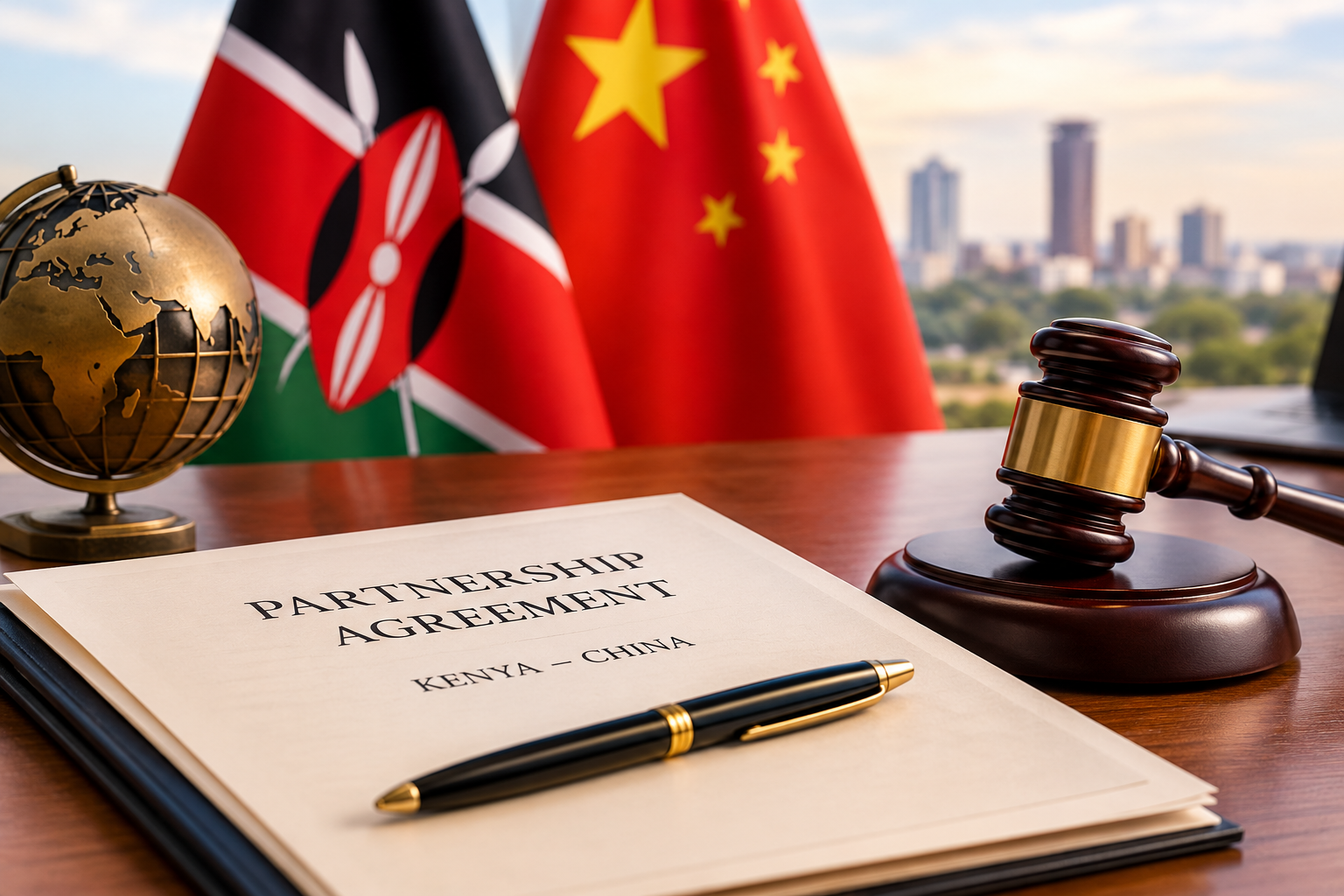
When news broke that Kenya and China had elevated their relationship to a Comprehensive Strategic Partnership (CSP), the headlines were filled with optimism. The language was familiar cooperation, shared prosperity, mutual benefit. Yet, behind the polished press statements and ribbon-cutting ceremonies lies a series of contracts, financing instruments, and legal frameworks that tell a far more complex story one that touches directly on sovereignty, transparency, labour rights, and accountability.
As lawyers, we know that in international cooperation, the real partnership lies in the fine print.
I. The Architecture of Power — Framing Economic Cooperation
At the heart of the CSP is the proposed Framework Agreement on Economic Partnership for Shared Development a document that will anchor future trade, investment, and infrastructure cooperation. On paper, it reads as a symbol of friendship. In practice, it creates the lex specialis, a new legal order governing Kenya–China relations, one that may override general multilateral trade rules under the WTO.
This is where Kenya’s legal advisors must tread carefully. Every clause matters from investment protection standards to dispute settlement provisions. If drafted without balance, these instruments risk entrenching asymmetry under the guise of development cooperation.
China’s prior agreements across Africa have often favoured the China International Economic and Trade Arbitration Commission (CIETAC) in Beijing as the sole dispute resolution forum, applying Chinese law as the governing law. For Kenya, this creates a structural disadvantage. It means that any disagreement whether over a construction defect, loan repayment, or environmental compliance would be adjudicated under foreign law, in a foreign capital.
This is not partnership; it is jurisdictional surrender.
II. The Sovereignty Clause — The Hidden Cost of Development
Perhaps the most troubling feature in prior Sino–Kenyan loan agreements is the waiver of sovereign immunity.
Many Chinese-financed projects, including the Standard Gauge Railway (SGR), required Kenya to waive immunity both from suit and from enforcement. In practical terms, this means that if Kenya were to default or breach a contract, its commercial assets not necessarily core state property, but potentially strategic national assets could be attached or seized in satisfaction of an arbitral award.
Even if symbolic, such clauses erode the core principle of sovereignty the legal shield that protects states from external enforcement against their will. They also raise serious constitutional concerns under Article 2(6) and Article 201 of Kenya’s Constitution, which emphasize national interest, prudent financial management, and transparency in public debt obligations.
III. Labour Infractions and Local Content — The Unkept Promises
The CSP, like its predecessors, is replete with promises of job creation, technology transfer, and industrial growth. But the reality on the ground often tells a different story. Many major infrastructure projects are dominated by Chinese contractors, imported materials, and expatriate labour. Local firms are subcontracted for peripheral tasks, while critical engineering, supply, and technology functions remain closed off.
This raises not only economic equity concerns but also labour law violations. Reports of discriminatory pay, poor working conditions, and exclusion of Kenyan professionals point to systemic weaknesses in enforcing labour standards in foreign-led projects. The Labour Institutions Act, the Employment Act, and Article 41 of the Constitution on fair labour practices are not optional they are binding, yet often sidelined by opaque contract structures and weak monitoring.
If the CSP is to mean anything, local content must be contractual, not ceremonial.
IV. The Transparency Deficit — Confidentiality vs. Public Oversight
A recurring feature of Kenya–China agreements is the confidentiality clause. Typically, the borrower Kenya is prohibited from disclosing contract terms without China’s written consent. On the surface, this protects commercial interests. In reality, it shields debt terms from parliamentary scrutiny, impeding the public’s constitutional right to information (Article 35).
This opacity fuels public distrust and undermines fiscal accountability. In a constitutional democracy, no foreign partner should have the power to determine what information the Kenyan public can access about its national debt.
The next generation of Kenya China contracts must include transparency carve-outs allowing disclosure to Parliament, the Auditor-General, and oversight agencies without breaching commercial confidentiality.
V. The Path Forward — Legal Precision as Sovereign Protection
Kenya’s lawyers and policymakers stand at a pivotal juncture. The Comprehensive Strategic Partnership can either deepen dependency or redefine engagement on equitable, transparent, and sustainable terms. To secure Kenya’s future, several legal imperatives must guide all CSP-related transactions:
Neutral Forums & Law – Arbitration under Kenyan or neutral law (e.g., UNCITRAL Rules) with accessible venues like the Nairobi Centre for International Arbitration (NCIA).
Sovereign Safeguards – Explicit exclusions for core state assets from any waiver of immunity.
Mandatory Local Content – Binding obligations on technology transfer, local procurement, and labour participation with measurable metrics.
Transparency Clauses – Constitutional compliance through lawful disclosure provisions.
ESG Integration – Every project contract must embed enforceable environmental, social, and governance standards aligned with Kenyan law.
Conclusion: Towards Legal Sustainability and Economic Sovereignty
The Kenya–China Comprehensive Strategic Partnership is more than a diplomatic statement, it is a binding set of legal relationships that will shape Kenya’s sovereignty, economy, and governance for decades.
For Kenya, the true test of partnership will not be how many kilometres of road are paved, but how well our contracts protect our people, our laws, and our future.
Sovereignty is not lost in battle , it is often signed away in silence. The task before our legal fraternity is to ensure that every clause we sign, every agreement we ratify, upholds Kenya’s constitutional promise: that development shall never come at the expense of our independence, our labour, or our dignity.
Disclaimer :This publication is provided for general information purposes only and does not constitute legal advice. Specific legal advice should be obtained for individual matters.
CM Advocates LLP – Contact details
Head Office – Nairobi
I&M Bank House, 7th Floor
2nd Ngong Avenue
Nairobi.
Mombasa Office
Links Plaza, 3rd Floor
Links Road, Nyali
Mombasa.
E: mombasaoffice@cmadvocates.com
Regional Presence: Uganda | Tanzania | Rwanda | Zambia | Ethiopia | South Sudan